

Second in a three part series on the future of marketing research practices. To read part one on how emerging media behaviors are affecting research practice, click here.
Today I will focus on the impact of changing marketing questions on research approaches.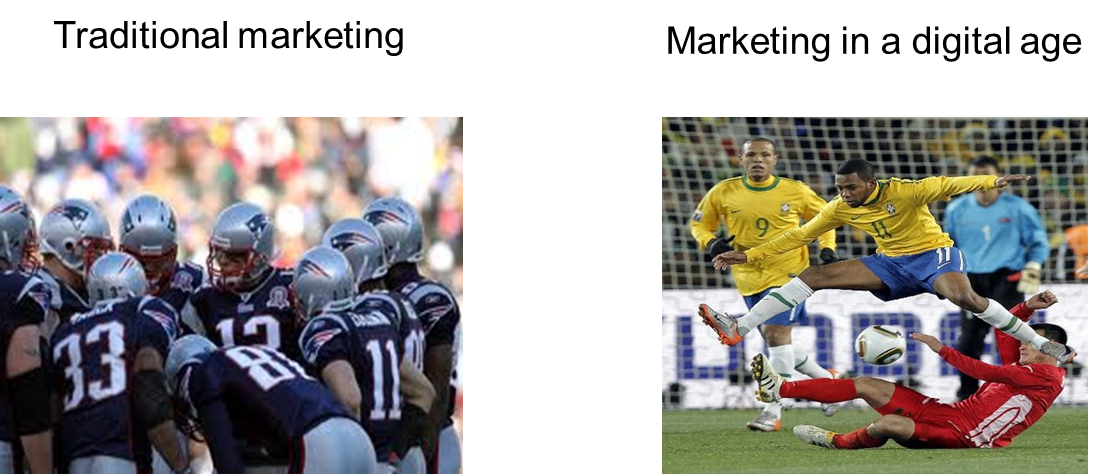
In a traditional marketing era, marketers built brands largely based on running paid advertising to generate awareness, interest, desire, and hopefully action. In this worldview, consumers were not part of the media equation.
In a digital, social, and mobile world, consumers can be a significant part of the media process as they:
- Share, endorse or dissuade friends regarding branded content and their feelings about brands
- Lean-forward as they search, pull information, and seek opinions. For example, Google told me in an interview last year that there are 8 BILLION US monthly food recipe related searches.
- Join brand communities via Facebook, Twitter, signing up for e-mails, and downloading branded apps.
A great articulation of this contemporary view comes from Coca-Cola who put its new vision on Youtube for marketing and new measurement systems, called “Liquid and Linked”. You will also be amazed by the way the storytelling is done.
Marketing used to be like football. Launch and run campaigns and wait to hear the post-mortem from research on how successful they were. Run a play, call time out to huddle up, then decide what play to run next.
Now, best marketing practice is more like soccer; constant action in the form of responding to consumer-initiated conversations in social media, search and digital behaviors across screens that are 365/24/7. Even paid digital advertising is constant as it is no longer time-restricted the way TV advertising is restricted to the time the show airs. Soccer marketing requires agility as you could be anywhere on the field at any point in time.
New marketing questions
Overall, the best statement of the new marketing challenge I have heard comes from Clive Sirkin, the CMO at Kimberly-Clark who states, “It’s about lean marketing in a digital age”.
Important marketing needs that research must respond to are:
- How much of my marketing budget should I deploy to digital?
- How do I encourage amplification of brand communications via consumer sharing?
- How well am I practicing ‘always on’ marketing where consumers are seeking my brand out and connecting with me at days and times of their choosing via social, search, and websites?
- How do I measure the relative impact of traditional, paid digital, earned and owned media?
- How can I improve the effectiveness of my campaign in flight?
- What are people saying about my brand in social media conversation?
- What is the total reach of my media across all screens?
- When and how do I commit to mobile in a big way?
Soccer research is the enabler of soccer marketing. Embrace the power of digital and social data, finding strategies for creating holistic insights and metrics delivered at the speed of light. I advise my clients to embrace a few “musts” for marketing research’s future:
- Integrate social media metrics, search, and web metrics into your brand KPI systems. For example, create common themes between social media listening and survey attribute factors so you can measure what percent associate a theme with your brand and naturally, how do consumers articulate that theme.
- Create marketing mix modeling approaches that leverage these same digital and social data streams. Also create knowledge systems that can comfortably integrate what is learned from experiments and from large regression models. This way, you can get ahead of emerging media options like mobile geo-fenced advertising before they reach scale.
- Turn every digital campaign and Facebook update from your page into a naturally occurring experiment where results can be reported in near real time. Create a tagging structure that will allow you to quickly identify in-flight what is working so you can redeploy dollars to the media targeting and creative combinations that are working best. This also means you need a strategy for measuring conversions even if you are not selling your products online.
- Learn from Facebook profiles and Twitter conversations what are the important interest, and lifestyle aspects of those who are into your brand. This has immediate ad targeting value, as these interests are part of the Facebook API. Want to learn if an attribute is important? Instead of regression analysis from a survey, place ads based on that attribute and see what response they get! Isn’t that the ultimate proof that the attribute matters to (potential) customers of your brand?
- Use digital, social, and customer research panels to get ginormous sample pools that can be sub-sampled in order to drilldown into important consumer and shopper sub-segments.
Stuck in the mud researchers need to stop viewing social media conversation as an imperfect sample and start thinking of it as a near CENSUS of something that marketers are trying to achieve; buzz, amplification, and ambassadorship. In addition, it has been statistically proven to be highly correlated, if done correctly, with survey metrics of brand health.
Over time, progressive client research teams will reduce their costs for data collection, redeploying these funds to where insights value creation now occurs: synthesis of disparate data streams into insights that lead to action and improved marketing productivity.
Note: the football vs. soccer marketing analogy was something I first heard from Wally Marx in a speech, the person who launched Soft Soap and a great thought partner for me over the past 30 years.
Contribute to Discussion »