

I recently had the pleasure of interviewing Alec Maki, a recipient of the annual AMA 4 Under 40 award, which recognizes emerging leaders in the field of marketing research who seek to advance the discipline. Fresh perspectives from a rising star…here you go!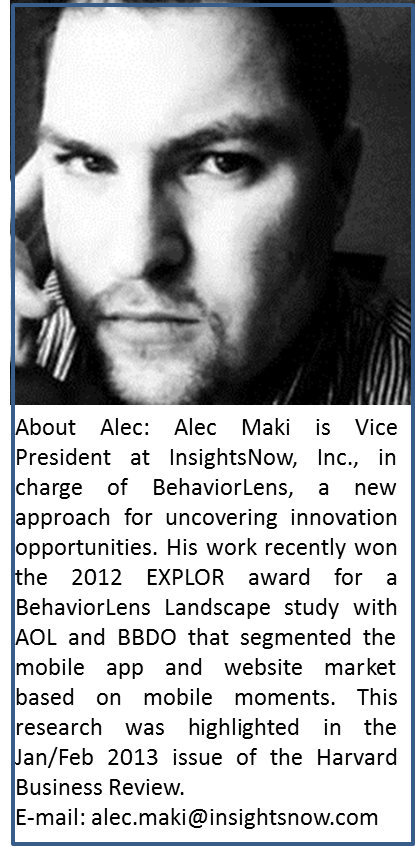
Q. Alec, you recently wrote an interesting blog on dysfunctional insights. Can you briefly explain the idea?
What I’m talking about is negative business impact that results from specialized insight functions. In larger companies, specialization comes from the necessity of satisfying the decision-making needs of different stakeholders. For example, shopper insights may serve category managers, consumer insights may serve brands, and product insights may serve R&D.
Each insight function has a mission to break the customer into pieces that each owns and fiercely protects. When marketing teams try to stitch the pieces into a whole, the resulting view of the customer is often incoherent and incomplete. Instead of a deep, empathetic, human picture, we get an image of something slapped strangely together – more akin to what you might see in a low-budget zombie movie.
In other words, insight functions are functionally driven to dehumanize the customer experience. Yet, if any function in a company should be empathetic to the full human experience of the customer, it should be insight. Ironic, no?
Q. What is the worst example of dysfunctional insights you have seen?
This kind of thing happens all the time. In the past month alone, I’ve spoken with three clients who are fighting against the inertia of dysfunctional insight. One is a major snacking brand that has struggled for years to extend into new flavors and formats. While the core product has been a success, new efforts to grow the brand have met with mediocrity. There’s a clear disconnect between consumer insight and product insight. Over and over again, consumer insight informs marketing “here’s what we need to make” – based on one view of the customer experience. Product insight provides guidance to R&D that hits the mark – based on a different perspective of the customer. The market responds with a dull, hollow thud. Over and over. Rinse and repeat.
Think about the total organizational impact. Years of poor in-market performance. As bad as this sounds, it’s just business as usual. That’s what makes dysfunctional insights so dangerous. They’re innocuous. Nobody’s the wiser because it’s the way things are. Dysfunction becomes standard operating procedure.
Q. Why do clients make such mistakes? Is there something structurally wrong with research approaches or organizations?
What is structurally wrong is that the foundation of customer understanding has been fractured through specialization. When it comes to insight, we are specializing the human out of the customer. There are experts in consumer research and shopper research but rarely do they understand the other person’s perspective. Digital might be foreign to both. Those who manage syndicated sales tracking data, like Nielsen, IRI, or NPD are yet another specialty. Even in media companies, you see splits between “traditional” and “new” media research. Marketing teams are also to blame. They think of consumers and don’t care about the 99% of their day that is involved with other products, services, and daily choices. We need to think of people as humans and holistically see their daily needs, concerns, and situations or we will be stuck with incremental thinking. In the real world, the end customer is the shopper is the person viewing the ad is the person collecting the coupon is the person posting to Pinterest. It’s the same person.
Busting up this specialization is how we were able to achieve breakthrough insights for AOL and BBDO regarding smartphone use. (More on the study can be found here.) We recast the mobile app and website market by segmenting different types of mobile moments based on their underlying motivators. Using the moment as the “lens” to frame customer understanding, we were able to integrate information from multiple sources: ethnography, in depth interviews, survey and 24/7 metered mobile behavior. Both small and big data in one design.
Q. What is your recommendation for client organizations? How can they make their insights more well, insightful and truly bring value to the enterprise?
This is a two-part challenge. The first is leadership. Without leadership to galvanize cross-functional insight teams, this is difficult. Second, companies must move from a fractured view of the customer to a single shared view. I liken this to a canvas and with each insight function being a painter – working together to paint a vibrant mural of customer understanding.
To do this, we need common information frameworks to provide the lens from which to view the customer. In our work with AOL and BBDO, we accomplished this using the landscape of smartphone moments as the common framework – through a blend of behavioral science, research method and technology.
This type of approach provides cross-functional teams with a common, actionable view of the market. Within and across initiatives, teams can execute using the same lens of the customer, ensuring a consistent frame of reference for decision-making.
Contribute to Discussion »